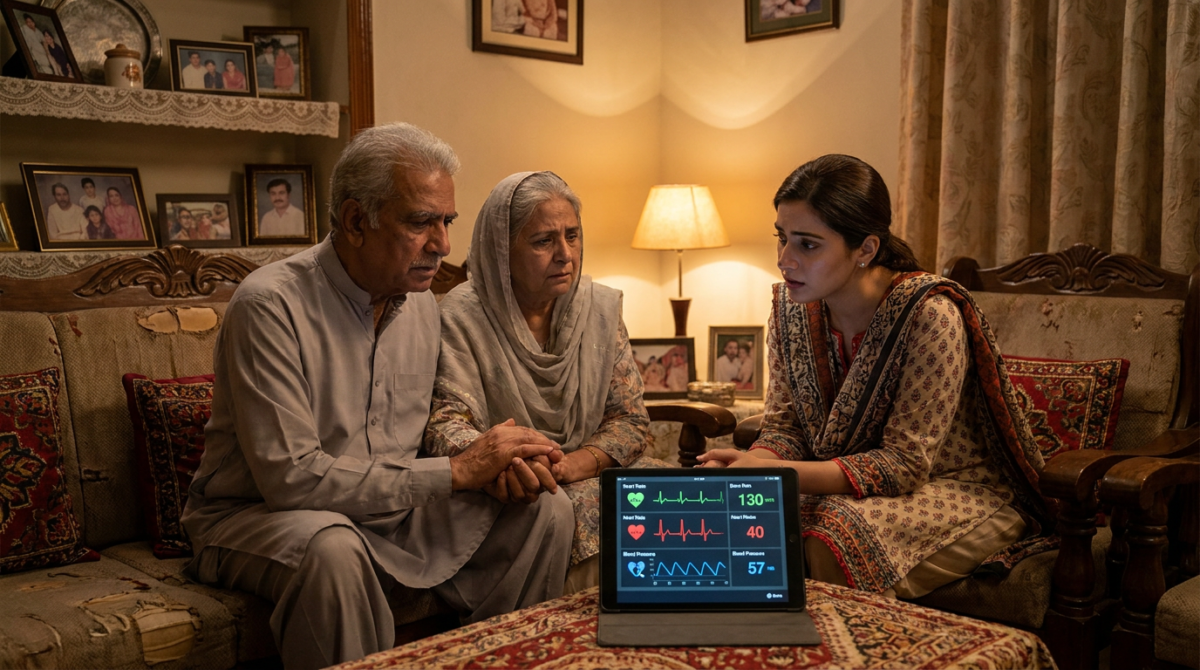
Think about the last time your parents saw a doctor — not because something was wrong, but just to check everything was okay. For most Pakistani families, that answer is uncomfortable. It may have been years. It may have never happened at all. And the response, if you raise it, is almost always the same: “I feel fine. What’s the need?”
That feeling of being fine is not reassurance. It’s the problem.
The Most Dangerous Diseases Feel Like Nothing at All
Cardiovascular disease accounts for more than 20% of all deaths in Pakistan — making it the single largest killer in the country. The vast majority of those deaths are preceded by years of silent, symptom-free disease development. Arteries narrowing. The heart compensating. Blood pressure creeping upward. None of it felt.
A landmark study found that 78.5% of Pakistani adults had never had their blood glucose checked. Never. Not once. These are people who may have been living with type 2 diabetes for years — with their kidneys quietly failing, their nerves slowly deteriorating, their blood vessels narrowing — while going about their daily lives with no idea anything was wrong.
The lungs tell a similar story. Chronic obstructive pulmonary disease — caused by years of exposure to smoke, indoor pollution, or city smog — reduces lung capacity gradually, over decades. Most people don’t notice until they’ve lost 40–50% of function. By then, irreversible damage has been done.
Feeling fine is not a clean bill of health. It is simply the absence of a symptom severe enough to force action.
Why Your Parents Don’t Go to the Doctor
It is easy to frame this as stubbornness or denial. But the real reasons are more understandable — and more structural.
- “There’s nothing wrong, so why go?” — Prevention culture is weak in Pakistan. Healthcare is reactive. You go when something hurts, not to check that nothing does.
- Access barriers — A specialist visit in a major hospital means arranging transport, waiting hours, navigating an overwhelming system, and often paying fees that feel unjustifiable when you’re not sick.
- Dismissal of vague symptoms — Fatigue, occasional breathlessness, mild chest discomfort — these are attributed to age, heat, stress. They are rarely connected to a potentially serious underlying cause.
- “I’ll go if it gets worse” — The intention to act is there. The threshold for action is set far too high. By the time it “gets worse,” the opportunity for early intervention has often passed.
None of these are failures of character. They are the predictable result of a healthcare system that has made prevention inconvenient and reactive care the norm.
What a Clinical Examination Actually Catches — That Your Parents Don’t Know Is There
This is what a thorough remote clinical examination can find in a parent who “feels fine”:
- Elevated blood pressure — A reading of 155/95 might have been there for two years. No symptoms. Silently straining the heart and narrowing the arteries. A five-minute measurement catches it immediately.
- Abnormal heart sounds — Murmurs, irregular rhythms, early signs of valve disease, or cardiac enlargement are audible through a digital stethoscope to a trained doctor — and completely undetectable to the person carrying them.
- Reduced lung function — Abnormal breath sounds and airflow patterns indicate early respiratory disease long before breathlessness becomes impossible to ignore.
- Low oxygen saturation — Chronically reduced SpO₂ points to cardiovascular or pulmonary compromise that has been developing quietly for months or years.
- Early retinal changes — Diabetic retinopathy — the leading cause of preventable blindness — shows up in the retina years before vision loss is noticed.
- Abnormal pulse patterns — Atrial fibrillation, the most common cardiac arrhythmia, dramatically increases stroke risk and often produces no sensation whatsoever.
Any one of these findings changes what happens next. All of them are catchable. None of them require a hospital.
The Conversation Most Families Avoid Until It’s Too Late
Pakistani families are close. Children take responsibility for parents seriously. And yet the healthcare conversation is routinely deferred — until a crisis forces it.
The heart attack that “came from nowhere.” The stroke that “no one expected.” The kidney failure that “happened so fast.” These events almost never actually come from nowhere. They are the culmination of years of undetected, unmanaged disease — disease that regular monitoring would have caught.
The regret that follows is universal, and it is entirely preventable.
Getting Your Parents Checked Has Never Been Easier
CARELINE’s remote clinical examination brings specialist-grade assessment to your nearest partner pharmacy — no hospital, no referral, no hours of waiting. A trained CARELINE health facilitator uses the eEVA™ device to conduct a comprehensive clinical examination in under 20 minutes. A qualified doctor reviews everything in real time and provides immediate findings and recommendations.
Heart sounds. Blood pressure. Oxygen saturation. Lung function. Pulse rhythm. Eye assessment. All of it, at a pharmacy near you.
The next time your parent says “I feel fine, there’s no need” — that is exactly the moment to book the appointment. Feeling fine is not a reason to wait. It’s the perfect time to confirm everything actually is.
Book a CARELINE examination for your parents today.
It takes two minutes and could change everything.
📱 WhatsApp: +92 310 2145333
📧 contact@thecareline.org
Specialist-grade remote examination. At your nearest pharmacy.
Frequently Asked Questions
What is CARELINE telehealth?
CARELINE is Pakistan’s first DRAP-licensed telehealth provider that uses the eEVA™ device — developed by Finland’s 73Health — to deliver real remote clinical examinations. Unlike video-call-only services, eEVA enables digital stethoscopy, lung sounds, ENT examination, and dermatological assessment, all without visiting a hospital.
How does the eEVA™ device work?
The eEVA™ (electronic EVAluation) device is placed on the patient at a CARELINE-enabled pharmacy, workplace, or home visit. It connects to a specialist doctor via live video who performs a full clinical examination in real time — listening to your heart and lungs, examining your ears, throat, and skin — exactly as they would in a clinic.
How much does a CARELINE consultation cost?
CARELINE offers flexible pricing for individuals, families, and corporate clients. Contact us at contact@thecareline.org or WhatsApp +92 310 2145333 for a personalised quote. Corporate and bulk packages are available.
Is CARELINE available outside Karachi?
CARELINE is currently operational in Karachi and rapidly expanding to Lahore, Islamabad, and other major cities across Pakistan. Remote consultations via home visit or workplace are available across Pakistan wherever an internet connection exists.
Is CARELINE DRAP certified?
Yes. CARELINE holds DRAP Import Licence No. ELI-EN00000073, certifying the eEVA™ device as a safe and fully compliant medical device for use in Pakistan. All consultations are conducted by qualified, registered medical professionals.
How do I book a CARELINE examination?
Booking takes under 2 minutes. WhatsApp us at +92 310 2145333, email contact@thecareline.org, or visit our services page. We are available 24 hours a day, 7 days a week.
Book Your CARELINE Remote Examination Today
Pakistan’s healthcare challenges are real — but with CARELINE’s eEVA™ technology, access to specialist-grade clinical care is no longer limited by geography or hospital waiting times. Whether you need a cardiac assessment, a lung check, an ENT consultation, or a general examination, CARELINE brings the doctor to you.
Explore our full range of CARELINE telehealth services or learn more about how it works on our general information page. For questions about CARELINE’s mission and team, visit the about CARELINE page.
📱 Book now via WhatsApp: WhatsApp +92 310 2145333
📧 Email: contact@thecareline.org
🌐 Website: thecareline.org
⏰ Available: 24 hours a day, 7 days a week
Get Your Remote Clinical Examination Today
Pakistan's only eEVA™-certified telehealth provider. Cardiologist-grade diagnostics from your nearest pharmacy or home — available 24/7.
🔒 DRAP Licence No. ELI-EN00000073 • ⚡ 2-Minute Booking • 🏢 Available Across Pakistan